

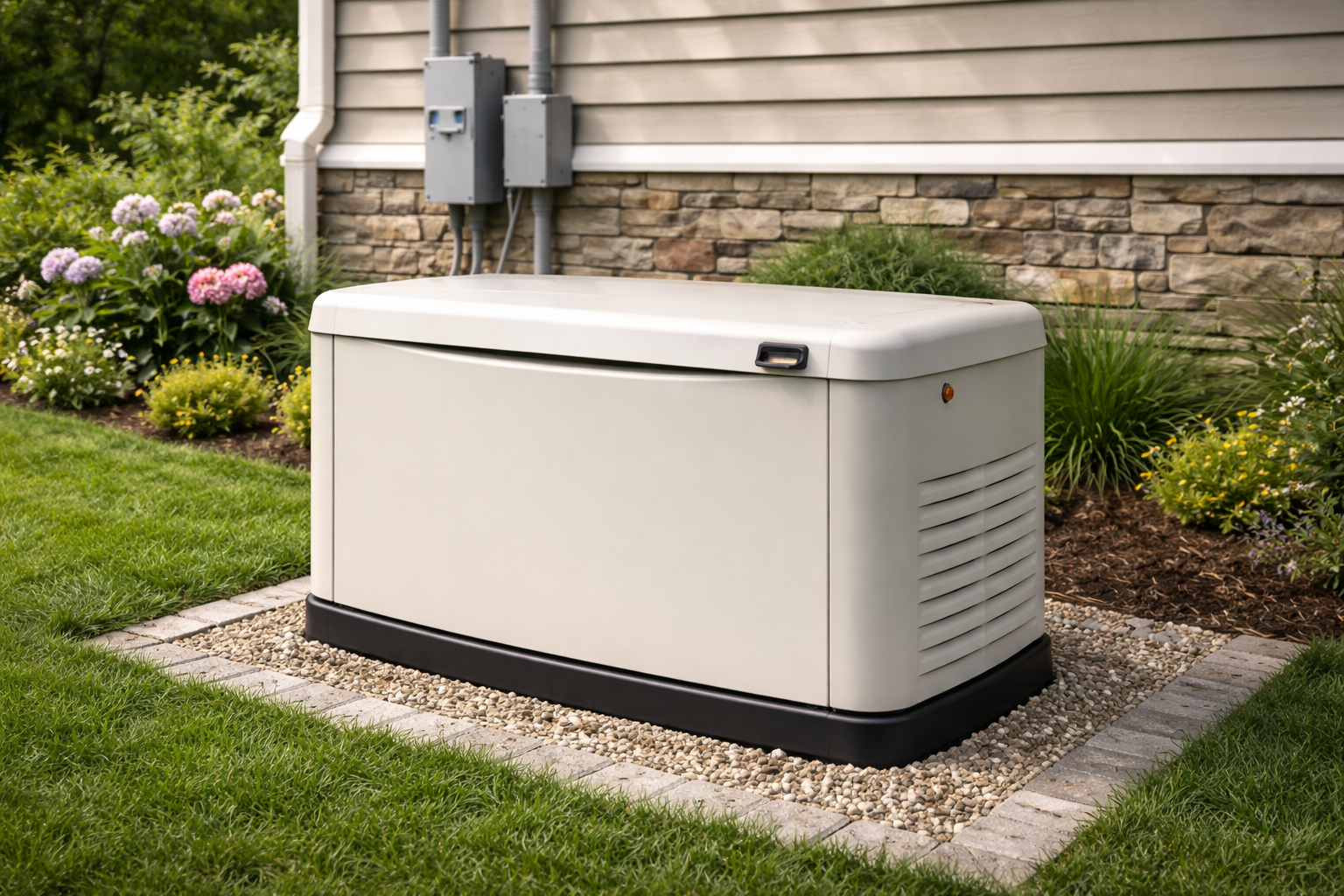
Hurricanes cause long outages, lightning surges, and voltage swings when power returns. Choose a generator sized for your loads, run it outdoors at least 20 feet from openings (or farther if the manufacturer or local code requires), connect it through a transfer switch or interlock, and layer surge protection at the panel and your devices. Have a licensed electrician handle installation.
This guide walks through both systems in the order you'd set them up. It draws on manufacturer guidance, safety agencies like the U.S. Consumer Product Safety Commission (CPSC), and what our electricians see in homes after storms.
Electrical Risks Hurricanes Create
A hurricane can cut power for days, then damage electronics when it returns. A power surge is a brief spike in voltage.
Power Outages and Voltage Swings
Voltage can spike and dip as utilities bring circuits back online.
A long outage means spoiled food, a stopped sump pump, no medical equipment power, and no cooling.
Lightning-Induced Surges
Nearby lightning can push surges through power, cable, and phone lines without a direct strike.
TVs, computers, routers, HVAC control boards, and appliances with electronic controls are most at risk.
Flooded Panels and Wiring
Floodwater damages panels, outlets, and wiring, which can shock or start fires. The inspection section below covers next steps.
Choose the Right Generator for Your Home
Most homeowners choose between a portable generator you wheel out and connect manually and a standby generator that's permanently installed and starts on its own.
Generator Type | Best For | How It Connects | Key Limitation |
Portable | Selected items | Cords or transfer switch | Manual setup |
Home standby | Whole-home coverage | Automatic transfer switch | Higher cost |
Inverter | Sensitive electronics | Cords | Lower output |
Battery power station | Phones, routers | Plug-in | Limited capacity |
Portable Generators
They cost less and can run a refrigerator, sump pump, lights, and internet equipment through extension cords. They need manual startup, refueling, and cord management. They can power household circuits only through an electrician-installed transfer switch or listed interlock.
Home Standby Generators
A home standby generator is permanently installed and connects through an automatic transfer switch. Our guide on weathering the storm with a whole house generator explains how these systems work. Installation involves:
Professional sizing: matches output to your loads.
Permits and inspections: keep the work code compliant.
Fuel supply planning: supports steady runtime.
Clearance and ventilation: keep exhaust away from the home.
Flood and wind protection: guards the unit during storms.
It also needs periodic testing and annual professional maintenance.
Inverter Generators
An inverter generator produces cleaner, more stable power for sensitive electronics and tends to run quieter. "Inverter" doesn't mean safe indoors, safe in wet conditions, or immune to overloads. All carbon monoxide, fuel, and placement rules still apply.
Battery Power Stations
They produce no exhaust and suit phones, routers, lights, and small medical devices.
Finite capacity: they run out.
Recharge time: it can be long.
High-startup appliances: they struggle with these.
Charging source: you'll need one after the storm.
Keep lithium-ion batteries dry and undamaged.
Generator Wattage You Need
Running watts are the power an appliance uses continuously. Starting watts are the brief, higher surge motors need to start, common in refrigerators, pumps, and air conditioners. Check each nameplate or manual for exact numbers.
Appliance | Typical Use | Note |
Refrigerator | Continuous | Motor needs starting watts |
Sump pump | Intermittent | High starting load |
Window air conditioner | Cooling | Check the nameplate |
Lights and internet equipment | Continuous | Low demand |
Medical device | As prescribed | Confirm with provider |
The 80 percent rule says to keep continuous load at or below about 80 percent of the generator's rated capacity, which avoids overloading it and leaves a buffer.
1. List Your Must-Have Appliances
Write down what must run at the same time, such as the refrigerator, sump pump, lights, internet equipment, and medical devices.
2. Check Wattage Labels
Find wattage on each label or in the manual, and note which motors need extra starting power.
3. Add a Safety Margin
Build in a buffer and stagger startups. Have a licensed electrician confirm sizing, especially for standby systems, HVAC, or well pumps.
Safe Generator Placement and Carbon Monoxide Protection
Never run a gasoline, propane, or diesel generator inside a home, garage, basement, crawlspace, shed, porch, or carport, even with doors and windows open. Carbon monoxide (CO) is an odorless, colorless gas that can reach dangerous levels quickly. The CPSC and other safety organizations recommend at least 20 feet from the home, while some municipal guidance says 15. The manufacturer's manual and local fire code control, so use the more protective distance.
Minimum Distance From Doors, Windows, and Vents
Outdoors only: on a stable, level, dry surface.
Exhaust direction: away from occupied spaces, combustibles, and neighbors' windows.
Don't place a generator under a deck or in a makeshift enclosure.
Elevate Above Flood Level
Floodwater, debris, and saltwater can damage generators. Local floodplain rules and a professional should set standby unit height. Never run a submerged generator until a qualified technician evaluates it.
Install and Test CO Alarms
Place alarms on every level and outside sleeping areas, and test them before hurricane season. An alarm is a backup warning, not a reason to run a generator indoors. If it sounds, get everyone outside and call 911.
Connect Your Generator With a Transfer Switch or Interlock
You can plug appliances directly into the generator with heavy-duty, outdoor-rated cords, or power household circuits through a transfer switch or interlock. A transfer switch shifts your home between utility and generator power so the two never connect at once. An interlock is a mechanical device on the main panel that does the same job.
Cord rating: outdoor-rated, with correct amperage.
Cord condition: no cuts, kept out of standing water, no daisy-chaining.
Avoid indoor power strips and lightweight household cords.
Manual Transfer Switch
You operate it by hand, and it typically powers selected circuits. It requires a generator inlet and professional installation.
Automatic Transfer Switch
It detects an outage and switches to a standby generator automatically, the standard pairing for standby units.
Backfeed Dangers
Backfeeding happens when a generator is plugged into a wall outlet, sending electricity backward into house wiring and utility lines.
Utility worker electrocution: crews expect lines to be dead.
Fire or overloaded wiring: circuits can overheat.
Generator damage: returning power can destroy it.
Never connect a generator to a wall outlet. Grounding and bonding setups differ by generator, so have an electrician verify them.
Fuel Storage and Safety Tips
Fuel shortages are common after major hurricanes, so plan runtime before a storm watch. Check the manual for fuel use at your expected load.
Approved Containers and Locations
Containers: use approved ones, and store only what local fire code allows.
Location: away from ignition sources and living areas, never in a basement or vehicle cabin.
Refuel After Cooldown
Shut the generator off.
Let it cool.
Move containers away.
Refuel outdoors.
Wipe spills and secure the cap.
Restart.
Spilled gasoline can ignite on hot engine parts.
Propane and Natural Gas Checks
Inspect regulators, flexible connectors, shutoff valves, and any flood damage. If you smell gas, don't run the generator, leave the area, and call the gas utility or emergency services.
Whole House Surge Protection Basics
A whole house surge protector is installed at or near your main panel and diverts excess voltage to the grounding system before it reaches your circuits. Lightning, utility switching, and restoration can all send surges through your wiring. No protector guarantees every device survives every event, because results depend on surge size, device ratings, grounding, and installation quality. Our surge protection explained article covers these devices in more detail.
Service Entrance Devices
Use listed, labeled equipment installed by a licensed electrician. The 2020 National Electrical Code added surge protection requirements for some dwellings, but your area's adopted code edition controls. Older homes may have no panel-level protection.
Safe Earth Paths for Surge Energy
Grounding and bonding are the connections that give surge energy a safe path to the earth. Short, straight wiring and a sound grounding system improve performance, which is why professional installation matters.
Indicator Light Inspections
Check the status light after major storms and replace the unit if it shows failure.
Plug-In Surge Protectors for Sensitive Electronics
A point-of-use surge protector protects only what's plugged into it. A basic power strip only adds outlets. Plug-in protectors work alongside a whole house device, not in place of one. Yes, use a listed protector for sensitive electronics on generator power, and connect it after the generator is running normally.
Feature | What It Tells You |
UL 1449 listing | Meets the safety standard |
Joule rating | Energy it can absorb |
Voltage protection rating | Let-through voltage |
Status indicator | Protection still works |
A higher joule number alone doesn't guarantee better protection.
What to Plug In and What to Unplug
Plug in computers, TVs, networking equipment, and office electronics.
Unplug extra electronics, chargers, and game consoles if it's safe.
Don't daisy-chain protectors. If you rely on medical equipment, coordinate your backup power plan with your healthcare provider and local emergency management.
Hurricane Season Generator and Electrical Checklist
Before the Season Starts
Test the generator under load.
Inspect cords and transfer equipment.
Change oil and filters per the manual.
Label the circuits you need most.
Test CO alarms.
Standby systems need professional annual maintenance.
During a Storm Watch and Outage
Charge battery stations.
Unplug sensitive electronics.
Keep the generator dry and outdoors.
Start the largest motors one at a time.
After the Storm
Avoid downed lines, and assume they're energized.
Stay out of standing water near electrical equipment.
Check for buzzing, burning odors, or sparks.
When utility power returns, turn off loads and let the generator cool before storing.
Flood-Damaged Electrical Equipment Inspections
Never energize equipment exposed to floodwater, even after it dries. Floodwater leaves corrosion and hidden insulation damage.
Why Drying Out Is Not Enough
Corrosion: weakens connections.
Damaged insulation: can cause shocks or fires later.
Equipment That Needs Professional Evaluation
Service panels, breakers, receptacles, generators, transfer switches, HVAC equipment, and EV chargers need a professional's review. If water reached your panel, contact your utility and a licensed electrician.
Frequently Asked Questions About Hurricane Generators and Surge Protection
Can a Portable Generator Damage My Electronics?
It can if it's overloaded or poorly maintained. Use a listed surge protector, and read more in our surge protection explained article.
Can a Generator Power a Sump Pump During a Hurricane?
Yes, if you account for the pump's high starting wattage. Our whole house generator guide covers sizing for storm needs.
Get Your Home Hurricane Ready With ABC Plumbing, Sewer, Heating, Cooling and Electric
Safe placement, a proper connection method, and layered surge protection keep your home safe and your electronics intact. The riskiest tasks belong with a licensed electrician: installing a transfer switch or interlock, sizing a standby generator, and adding whole house surge protection. Our licensed electricians offer upfront pricing and a satisfaction guarantee.
We serve Illinois, Northwest Indiana, and Florida, and we've served Chicago and Illinois homeowners for over 70 years. Contact us today to schedule your service or request an estimate.
Related blogs

Our Blog
VIEW ALL BLOGS
Boiler vs. Furnace: Which Heats Your Home Better?
-
How Much Does Furnace Repair Cost in Chicago, IL?
A furnace that quits during a Chicago cold snap makes every dollar question feel urgent. This guide covers what homeowners commonly pay and what moves the price.READ MORE -
Des Plaines Plumbing: DIY Fixes for Common Issues
Common plumbing problems like leaky faucets, clogged drains, running toilets, low water pressure, and water heater issues can disrupt your daily routine and lead to costly repairs if left unaddressed. This guide walks Chicagoland homeowners through practical DIY plumbing fixes, essential safety precautions, and warning signs that indicate when professional help is needed. It also covers more serious concerns, including sump pump failures, frozen or burst pipes, sewer backups, and hidden water leaks. Learn how preventive maintenance and timely service from ABC Plumbing, Sewer, Heating, Cooling & Electric can help protect your home, reduce unexpected expenses, and keep your plumbing system running smoothly year-round.READ MORE -
Tips for Selecting the Best Toilet for Small Spaces in Clearwater
Choosing the right toilet for a small bathroom can help Clearwater homeowners maximize space, improve functionality, and create a more comfortable, stylish bathroom. This guide explores space-saving options, including compact, corner, and wall-mounted toilets, along with water-efficient features like dual-flush technology that can help reduce water usage and utility costs. It also highlights the importance of selecting a reliable, high-quality toilet that complements your bathroom’s design. Learn how professional installation from ABC Plumbing, Air, Heat & Electric can help ensure proper performance, prevent leaks, and provide long-lasting peace of mind.READ MORE
Our Promises To You
-

Convenient For You
We Work on Your Schedule
-

Background Checks
We do Drug Tests And Background Checks Before Hiring
-

No Need For Stress
Get ABCs Worry-Free Guarantee at No Cost
-

No Surprises
Pricing is By the Job, Not the Hour